Demand charge management for EV charging sites
A demand charge is billed on your worst 15 minutes of the month — and EV chargers can double or triple it. Energy Guardian watches the meter in real time and holds that peak down, cutting demand charges 35–55%. Measured from interval data, not estimated.
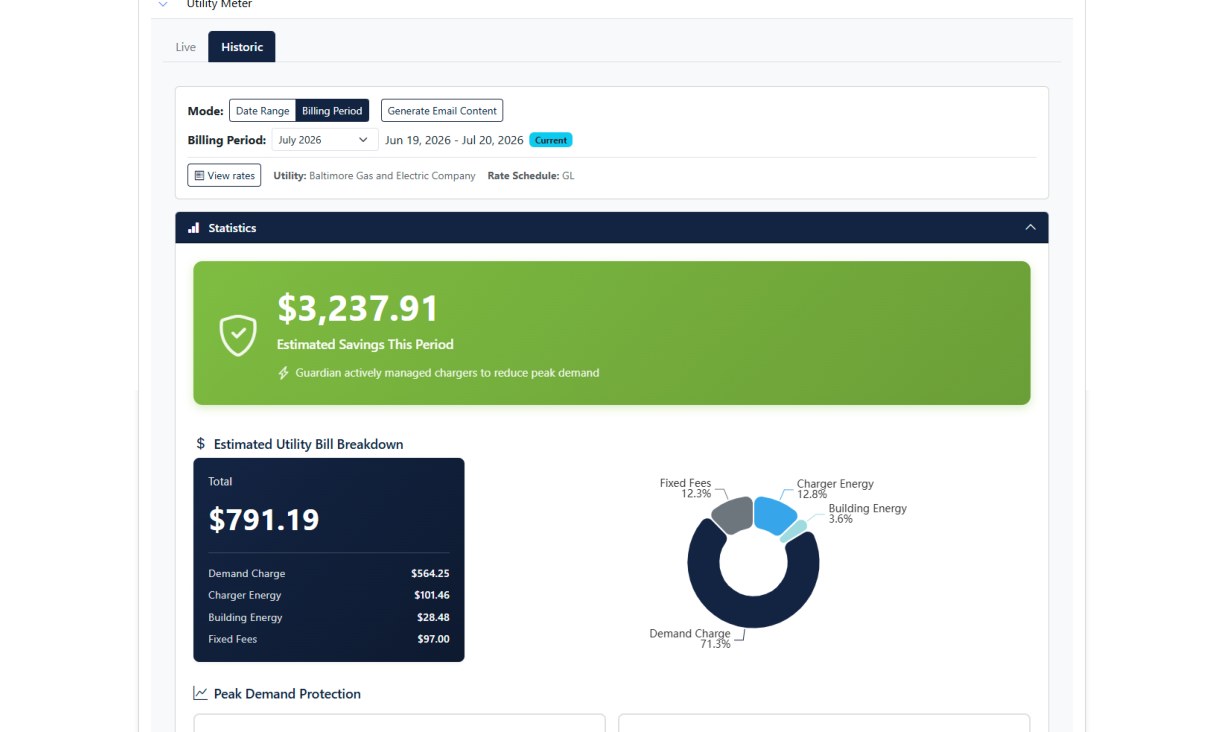
What demand charge management actually does
Demand charge management is how you stop paying for the single highest peak your chargers create. A demand charge isn't billed on the power you use — it's billed on the worst 15 minutes of the month. Add EV chargers to a commercial site and that peak jumps. Energy Guardian, EVready's managed load-management service, holds it down in real time.
One unmanaged interval sets the rate for the entire billing period, so the fix is surgical rather than restrictive — it touches a few minutes a month, not your operating hours. Want the full explainer instead? Read what a demand charge is and how it's calculated →
The numbers — measured, not modeled
Most vendors say load management saves money. Almost none publish the interval data. We do, because the shape of the data is the argument.
$25,089.84 in demand charges avoided over six months at Apple Ford Lincoln (Feb–Jul 2026, all meters) — by intervening in just 2.6% of intervals. A 371.3 kW peak was held to 57.3 kW. These are meter readings, not a model.
Higher-volume deployment, DC fast included
Mixed deployment, mid-Atlantic utility
Read the Apple Ford interval data → · See the Berger Chevrolet numbers →
Figures are drawn from Energy Guardian meter and charger telemetry for the periods stated, estimated against modeled unprotected peak demand at the applicable tariff, and published with each client's permission. Results vary by site, utility, and rate schedule. If your tariff has no demand charge, you don't need this — and we'll tell you so.
Measure, then manage the few minutes that matter
Measure
We read your real load and rate schedule at the interval level — the facts the bill is actually built from.
Model
We find where concurrent charging sessions collide with the building's own peak, and what that peak would cost unmanaged.
Optimize
Energy Guardian shapes charger output in real time so the site never sets a peak it didn't need to.
Verify
Savings are reported against your modeled unprotected peak — the only honest benchmark — not against last year's bill.
It isn't "charge only overnight." Blanket restrictions are the blunt instrument dealerships and fleets rightly refuse. Guardian constrains a handful of intervals a month, not the customer standing at the charger.
It isn't a battery. No storage hardware to buy, permit, or maintain — it's a managed service that shapes charger load against your utility's rate structure. See how Energy Guardian works →
Where demand charges hurt worst
Anywhere a few high-power sessions land on top of an existing building load. That's most of commercial EV charging.
Dealerships →
OEM-mandated chargers that spike the fixed-ops utility bill.
Fleets & depots →
Predictable duty cycles, punishing peaks when the yard plugs in together.
Multifamily →
Shared meters and thin operating margins that demand charges erode fast.
Parking operators →
Revenue chargers that shouldn't erase their own margin at the meter.
Public sector →
Government, education, and nonprofits — available on Sourcewell #041525-EVRY, no RFP required in most jurisdictions.
Every commercial site →
Not sure where you fit? Start with the estimator and we'll take it from there.
Questions buyers ask us
What is demand charge management?
How much can demand charge management reduce my bill?
Does it require batteries or new hardware?
Can public-sector organizations buy this without an RFP?
Find out what your peak would cost
Estimate the demand charge your chargers will add — then see what Guardian holds it to. No signup to see your number.
Run the demand charge estimator → Book a site review