Energy Guardian: cost management, not just charger management.
A rate-aware energy management platform from EVready® Energy. It measures the power behind your charging and building loads, prevents demand charge spikes before they set your monthly bill, and turns that control into measurable savings every period.
It isn't the electricity — it's the peak.
Most commercial bills are driven by the demand charge: a fee based on your single highest interval of power draw, not how much energy you use. One DC fast charger can set that peak even when it's barely used. Traditional charger software watches whether the charger is on. Energy Guardian watches what it costs you — and lowers it.
Measure → Optimize → Monetize
See where the money goes
Full visibility into consumption, peak demand, and rate exposure across every site and meter.
- Increase operational visibility
Stop overpaying
Smart charging and peak shaving shape load against your tariff to bring the costly peaks down.
- Reduce electricity costs
- Reduce demand charges
- Improve utility economics
Turn usage into savings
Qualify for utility programs and track the revenue and savings your infrastructure generates.
- Unlock utility program participation
- Generate measurable savings
The full picture, every billing period
Energy Guardian reports break down exactly what's driving your bill — and what was saved.
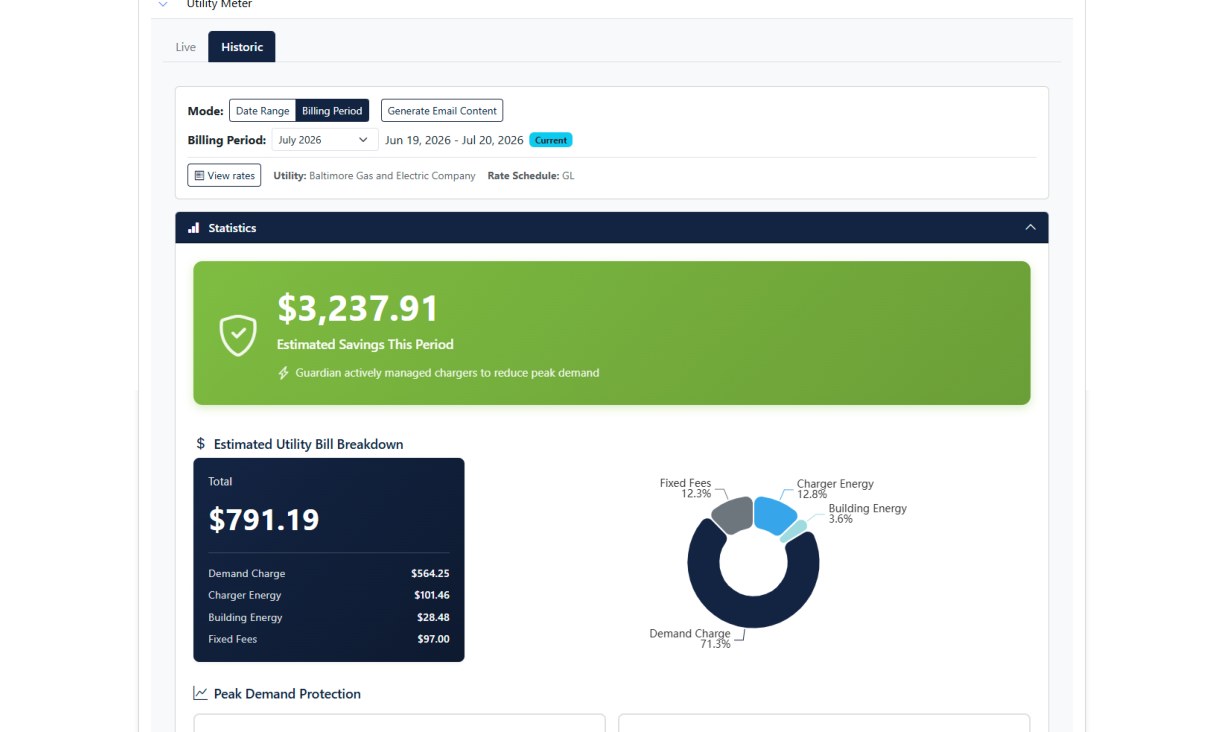
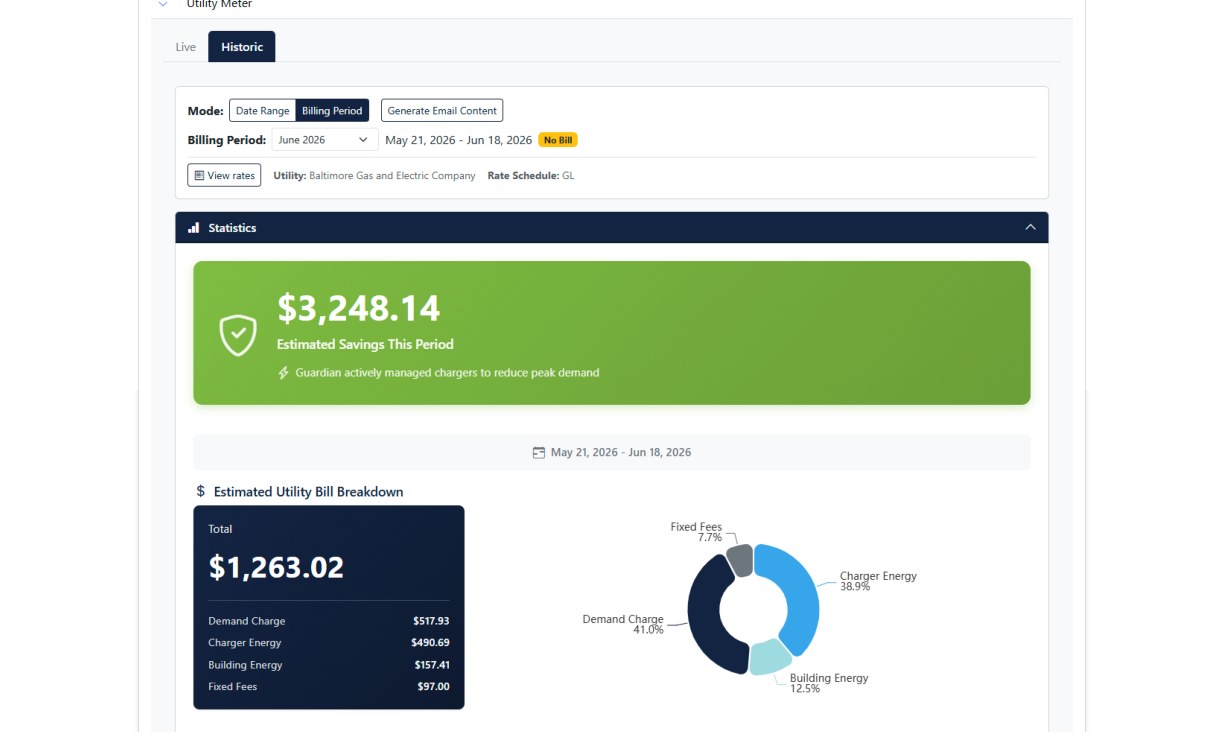
Estimated bill breakdown
Demand charge, charger energy, building energy, and fixed fees — see the share each drives.
Peak demand protection
Your peak without protection vs. the actual managed peak, with the dollars avoided.
Charger utilization
Sessions, energy delivered, and how hard each charger is actually working.
Protection frequency
How often Guardian actively intervened to hold your peak down.
Charger income
Network-reported session revenue, summed for the period, where chargers are paid.
Demand charge avoidance
A day-by-day view of peaks reached vs. peaks avoided across the period.
Works with the chargers you already have
Energy Guardian manages the energy regardless of charger brand — no rip-and-replace.
This is what your team sees every billing period
Real dashboards from live deployments — your peak demand, your bill breakdown, your savings, in one place.
Billing period view. The green banner updates every period with your estimated savings. Below it: the full bill breakdown and the unprotected peak vs. your actual managed peak.
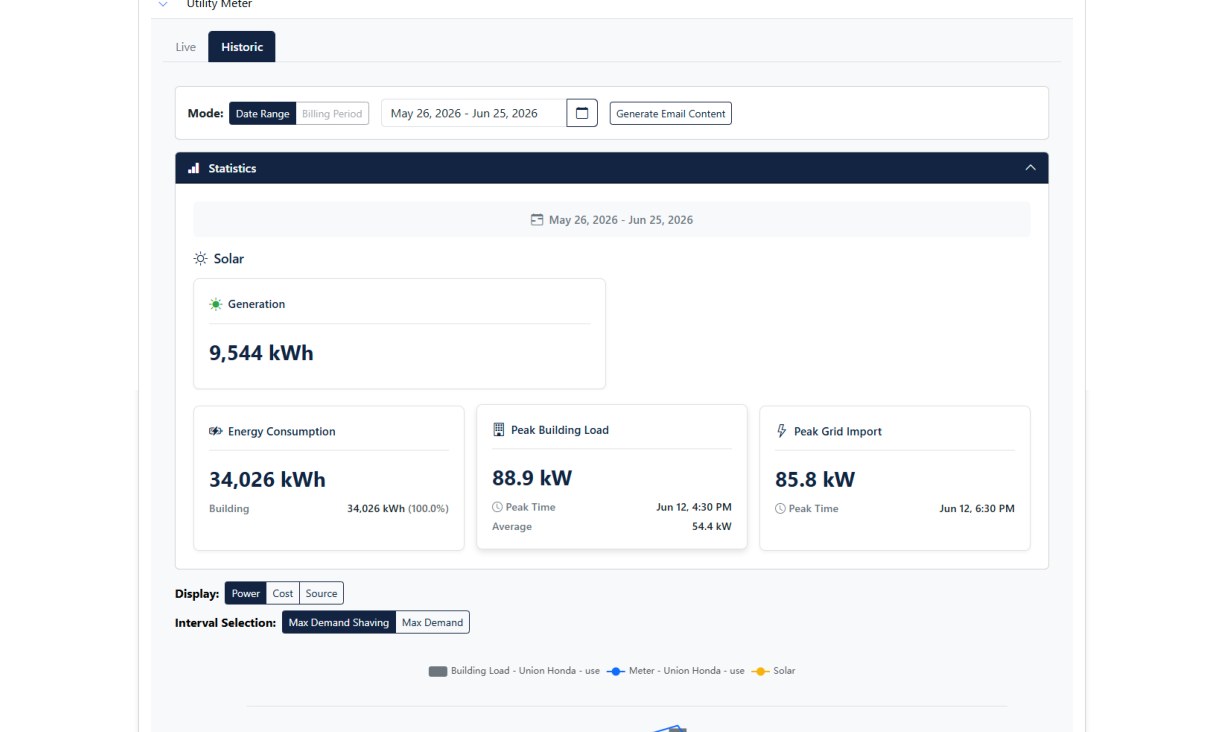
Live load monitoring. Real-time interval data with your demand threshold visible — Guardian is actively holding your peak below that line.
Historic interval chart. Day-by-day view of peaks reached vs. avoided — the green bars are demand charges Guardian prevented.
Measured savings from EVready Guardian reports
Estimated demand-charge savings from EVready Guardian reports. Actual results vary by site, load profile, and utility tariff.
What makes a building energy management system work for EV charging
For commercial and public-sector sites adding EV chargers, the useful definition of “best” is not a generic BMS scorecard. It is whether the system controls facility peak demand in real time so EV charging does not set avoidable demand charges — while staying network-agnostic and usable alongside the chargers you already have.
Energy Guardian is built for that job. It reads total building load, shapes EV charging against a demand ceiling, and targets the line item that actually drives commercial EV bills: the demand charge. Charger-only schedules and pure TOU timers help energy cost; they do not reliably stop coincident peaks. That distinction is why utilities are scaling active managed charging, and why commercial sites need the same idea at the meter.
| Capability | Energy Guardian | Typical EV software / charger mgmt | Generic building BMS |
|---|---|---|---|
| Facility-level demand ceiling | Yes — shapes EV load against total site demand | Often charger or schedule only | May not model EV coincidence |
| Demand-charge focus (kW peaks) | Primary design goal | Secondary or absent | Varies; rarely EV-specific |
| Network-agnostic (multi-brand chargers) | Yes | Often locked to one network | Integration project |
| Rate / tariff awareness | Yes | Sometimes TOU only | Varies |
| Measured interval-level results | Published with client permission | Rarely public | Internal dashboards |
| Delivery model | Managed service + install partner | Software or network subscription | Platform + integrator |
Why EVready over a standard EV charger installer
Most installers deliver hardware and leave. The bill risk — demand charges from coincident EV load — starts after they leave. EVready pairs certified installation with Energy Guardian so peak management is designed in from day one, not retrofitted after the first shocking invoice. For public agencies, that stack is available under Sourcewell contract #041525-EVRY.
Related guides: What is load management for EV charging · What is peak shaving · Demand charges 101 · Why TOU rates aren’t enough
Questions we get
What is Energy Guardian?
Is Energy Guardian the same as EVready Simplify?
How is it different from charger management software?
How does it save money?
Does it work with my existing chargers?
What does it cost?
What is a demand charge?
How quickly does Energy Guardian start saving money?
Does Energy Guardian affect the charging experience for drivers?
Can Energy Guardian help with demand response or utility programs?
Is Energy Guardian a building energy management system for EV charging?
How does an energy management system integrate with EV charging stations?
What should I look for in an EV-charging energy management system?
Which companies offer energy management systems for EV charging?
Does it support DC fast charging and fleet charging?
What is the best building energy management system for EV charging integration?
How does Energy Guardian manage building energy loads?
How does Energy Guardian prevent facility demand charge spikes?
Energy Guardian vs traditional EV charging software — what’s the difference?
Why choose EVready over a standard EV charger installer?
See what Energy Guardian would save you
A 30-minute call and a look at your interval data is all it takes to estimate your demand-charge savings.
Schedule an EV charging strategy call →Apple Ford Lincoln: a 371.3 kW unprotected peak held to 57.3 kW, and $25,089.84 in demand charges avoided over six months — with charging managed in only 2.6% of intervals.
Read the interval-level data →On honesty in a fluid market

They bring great knowledge on all the sources of funding, tax incentives, and grants — and their agnostic technical knowledge of all charger types gives us great peace of mind. I appreciate their honesty above all.