
Over the past decade, discussions about electrification have been dominated by political talking points, vehicle performance, and charging convenience. While those topics matter, the most critical component of modern civilization — the electric grid itself — is routinely mischaracterized or treated as a background assumption.
The North American grid is undergoing an immense overhaul. Nearly double the capacity will be needed over the coming decades. Until the modern century, the grid has operated as a largely one-way transmission and distribution system. That design creates deep inefficiencies in resiliency, sustainability, security, and economics.
The core problem: Utilities have limited incentive to move quickly on major grid modernization. Consumers and many businesses treat the electric bill as an unavoidable cost they don’t fully understand. As a result, the topic that most determines whether commercial EV charging is affordable remains the least discussed.
Key Takeaways
- The traditional one-way grid creates inefficiency, renewable curtailment, limited DER integration, and higher vulnerability to disruption.
- A bidirectional smart grid + DERMS delivers measurable gains in resiliency, economic optimization, sustainability, and security.
- Unmanaged commercial EV charging — especially DC fast charging — drives disproportionate demand-charge exposure (often 30–70% of the bill).
- Dealerships face unique risk from OEM-mandated fast charging, unpredictable daytime load, and aging site infrastructure.
- Private-sector platforms that deliver active load management, peak shaving, and V2G readiness are the practical bridge while the bulk grid modernizes.
- EVs can become grid assets rather than pure liabilities when charging is actively managed.
How Today’s Grid Works (and Why One-Way Flow Is Inefficient)
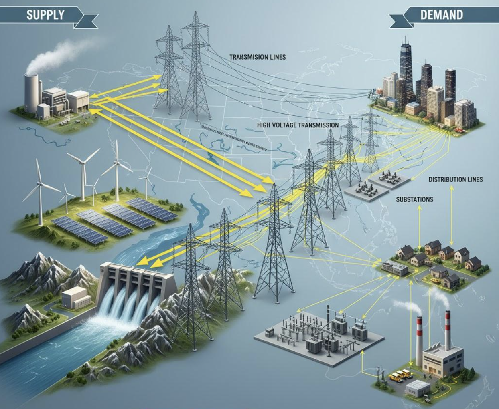
Electricity is generated at large plants, stepped up to high voltage, transmitted long distances, stepped down at substations, and delivered through local distribution lines. In a classic one-way system:
- Generation must match demand in real time — storage is limited.
- Excess renewable generation is often curtailed when local demand is low.
- Distributed energy resources (rooftop solar, batteries, EV fleets) are difficult to integrate.
- Centralized design increases vulnerability to cascading failures.
The Bidirectional Smart Grid Opportunity
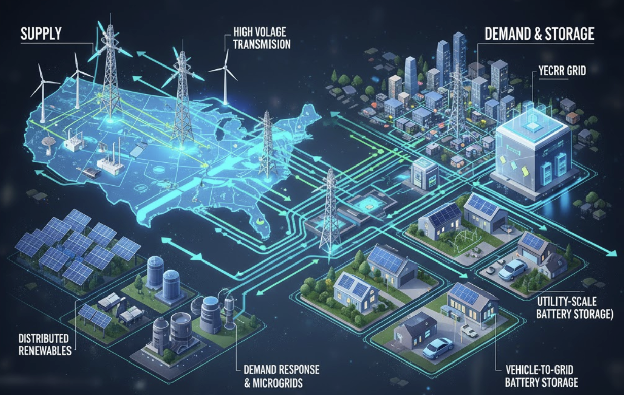
A bidirectional smart energy management system (often called a “smart grid”) introduces two-way power flow, advanced sensing, automated controls, and the ability to coordinate distributed resources. The benefits fall into four pillars:
1. Enhanced Resiliency & Reliability
- Self-healing capabilities that automatically re-route power around faults.
- Reduced reliance on a few distant power plants through local microgrids and islanding.
- Grid stabilization via DERs and stationary batteries that can absorb or inject power instantly.
- Vehicle-to-Grid (V2G) turning EV fleets into distributed backup and revenue assets.
2. Economic Efficiency
- Demand response that reduces non-essential load during peak price periods.
- Better utilization of existing infrastructure, delaying costly upgrades.
- Energy arbitrage — charge storage when power is cheap, discharge when expensive.
- Reduced line losses by generating closer to the point of consumption.
3. Sustainability & Decarbonization
- Maximized renewable integration by storing excess solar and wind instead of curtailing it.
- Support for millions of small distributed clean sources.
- Reliable handling of the massive new load from EVs and heat pumps.
Why Demand Charges Hit Commercial EV Sites So Hard
Demand charges recover the cost of building and maintaining grid capacity to meet a customer’s single highest 15-minute peak in a billing period. They are not based on total energy used. DC fast chargers can draw as much power as a small building for a short period. When multiple vehicles plug in simultaneously, that spike sets the demand charge for the entire month — even if overall utilization is low.
This creates a low-utilization paradox that is especially painful for early-stage charging sites and for dealerships required by OEMs to install fast charging.
Measured results already exist. On EVready-managed sites, active load management has held peaks far below unprotected levels — for example, reducing a potential 149.8 kW peak to 116.9 kW at Berger Chevrolet and delivering far larger reductions at higher-volume sites. See the full Berger Chevrolet case study and the interval-level data from Apple Ford Lincoln.
For a deeper explanation of how demand charges work and why EV chargers amplify them, read our foundational guide: What Is a Demand Charge?
The Private-Sector Bridge: DERMS, Load Management & Energy Guardian
While full grid modernization will take decades, private-sector platforms can deliver many of the benefits of a smart grid today. Distributed Energy Resource Management Systems (DERMS) aggregate and coordinate customer-sited assets — rooftop solar, batteries, EV chargers, and smart loads — so they can provide grid services and protect the host from demand spikes.
EVready’s Energy Guardian is designed precisely for this layer: rate-aware, network-agnostic load management that sits on top of existing ChargePoint, Blink, and other hardware. It measures, optimizes, and monetizes charging load so peak demand (and the bill behind it) stays under control.
For organizations still in the planning stage, our Consulting & Strategy work maps tariffs, models demand-charge exposure, sequences incentives, and produces a costed roadmap before any steel is ordered.
What Operators Should Do Now
- Measure — Pull interval data and model the demand-charge impact of planned or existing chargers.
- Manage — Deploy active load management before (or immediately after) installation rather than treating demand charges as inevitable.
- Stack incentives — Section 30C, utility make-ready, demand-response programs, and cooperative contracts (Sourcewell) can meaningfully change net cost.
- Design for the future — Specify V2G-capable hardware and software pathways so today’s charging assets can become tomorrow’s grid resources.
The right time to address demand charges is during planning, not after the first bill. A 30-minute strategy call gives you a clear view of tariff exposure, load-management potential, and the incentive stack for your sites. Book a strategy call.
Download the Full White Paper
The complete paper expands on grid history, ISO/utility roles, regulated vs. deregulated markets, national security considerations, projected EV load growth, and the policy landscape. It is free and ungated.